

From Kitchen Insight to Market Impact: Translating Culinary Ideas into Scalable Food Products
April 27, 2026
Most food brands don’t have an innovation problem. They have a translation problem.
Great ideas happen every day. A chef experiments in a test kitchen. An operator finds a better way to move through a line. A brand team notices what consumers keep coming back to on a menu. That’s where innovation starts, and it’s not where most brands struggle.
The challenge is turning that moment of insight into something that works at scale. Something that holds up in real kitchens, earns operator trust, and ultimately drives repeat purchase. The gap between kitchen insight and market impact is where even strong ideas lose momentum.
The reality: innovation doesn’t fail in the kitchen
A product can be technically sound, even compelling in early testing, and still fall short once it enters the market. Not because it lacks quality, but because it doesn’t fully align with how operators actually work.
In foodservice, products need to do more than taste good or meet a trend. They need to perform under pressure, fit into existing workflows, and deliver consistency across locations. When those elements are missing, adoption slows down or never happens at all.
Usability, not just creativity, is what ultimately drives success.
Why culinary insight is your most underutilized asset
Chefs and operators are often treated as the end of the process, when in reality they should be one of the first inputs. The way they use, adapt, or avoid certain ingredients provides an early and reliable signal of what will work at scale.
They are navigating real constraints every day. Labor challenges, evolving menu expectations, and the need for consistent execution across shifts and locations all shape how decisions are made. What they choose to prioritize, and where they are forced to improvise, reveals gaps that no trend report can fully capture.
The brands that listen at this level are better positioned to develop products that already fit into the realities of the kitchen, rather than asking operators to adjust around them.
Where innovation breaks down
Most brands don’t struggle with generating ideas. The breakdown happens in how those ideas are developed and brought to market.
A product might perform well in a controlled test kitchen but lose consistency in a high-volume environment. It may align with a current trend but overlook the operational realities that determine whether it can actually be used day to day. In many cases, marketing is brought in too late, resulting in a story that doesn’t reflect how the product delivers value in practice.
There is also often pressure to move quickly, which can lead to skipping key validation steps. The result is a launch that looks strong on paper but fails to gain traction where it matters most.
These challenges are common, but they are not unavoidable.
The shift: from idea-driven to reality-driven innovation
Closing the gap between insight and impact requires a more connected approach to product development. One that aligns culinary creativity, operational reality, and commercial positioning from the start.

- Start with operator reality, not category trends
Trends can provide direction, but they shouldn’t be the foundation. The most effective innovations solve specific problems that operators are already facing, whether that’s improving speed, reducing complexity, or increasing consistency. Starting from those realities ensures the product has a clear role before it ever reaches the market.
- Build the value story alongside the product
One of the most common disconnects in product development is timing. Teams invest heavily in formulation, sourcing, and packaging, then attempt to define the value proposition at the end of the process.
The stronger approach is to develop the story in parallel. Clarify early what problem the product solves, why it matters, and what makes it different. When that narrative is built alongside the product, it becomes much easier to communicate and much more compelling to buyers.
- Validate in real-world conditions
Performance in controlled environments is only part of the equation. Products need to be tested in the conditions they will actually face, including high-volume service, varying staff levels, and different operating environments.
This level of validation does more than improve the product. It builds confidence. And confidence is what drives adoption.
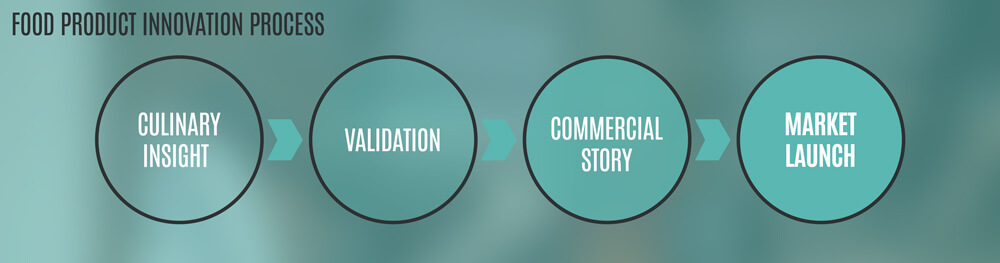
Making market impact measurable
The final step, and one that is often overlooked, is defining what success looks like beyond the initial launch.
For retail buyers, success is tied to velocity, shelf performance, and repeat purchase. For operators, it is about ease of integration, consistency, and the ability to deliver a reliable guest experience. For multi-unit operations, scalability and alignment across locations become critical.
When these outcomes are clearly defined early on, it becomes much easier to build a product and a strategy that supports them.
The bottom line
Culinary insight is where innovation begins, but it is not what drives growth on its own.
The brands that succeed are the ones that can translate that insight into products that work in the real world. Products that operators trust, buyers understand, and teams can consistently execute against.
Because in the end, the difference between a good idea and a successful product is not creativity. It is how well that idea holds up when it matters most.
At Omnivore, we work with food and beverage brands at every stage of this journey — from translating culinary insight into commercial strategy to building the launch narratives that drive real market traction. If you’re looking to close the gap between a great idea and a product that actually wins, let’s talk.
Ready to turn culinary insight into market impact? Let’s start the conversation.