

SEO, AEO & GEO for Food Brands: The 2026 Search Playbook
June 10, 2026
What Every Food Brand Needs to Know About Search in 2026
The Three-Discipline Search Framework That’s Separating Visible Food Brands from Invisible Ones
Search for food brands no longer means one thing. In 2026, a modern search strategy requires mastering three disciplines — SEO, AEO, and GEO — each optimizing for a different audience and output. SEO wins blue-link rankings. AEO captures featured snippets and voice results. GEO earns citations inside AI-generated answers from ChatGPT, Perplexity, Claude, and Gemini. Food brands that treat them as competing priorities will lose ground to those that stack them as layered disciplines.
|
What Is the Difference Between SEO, AEO, and GEO?
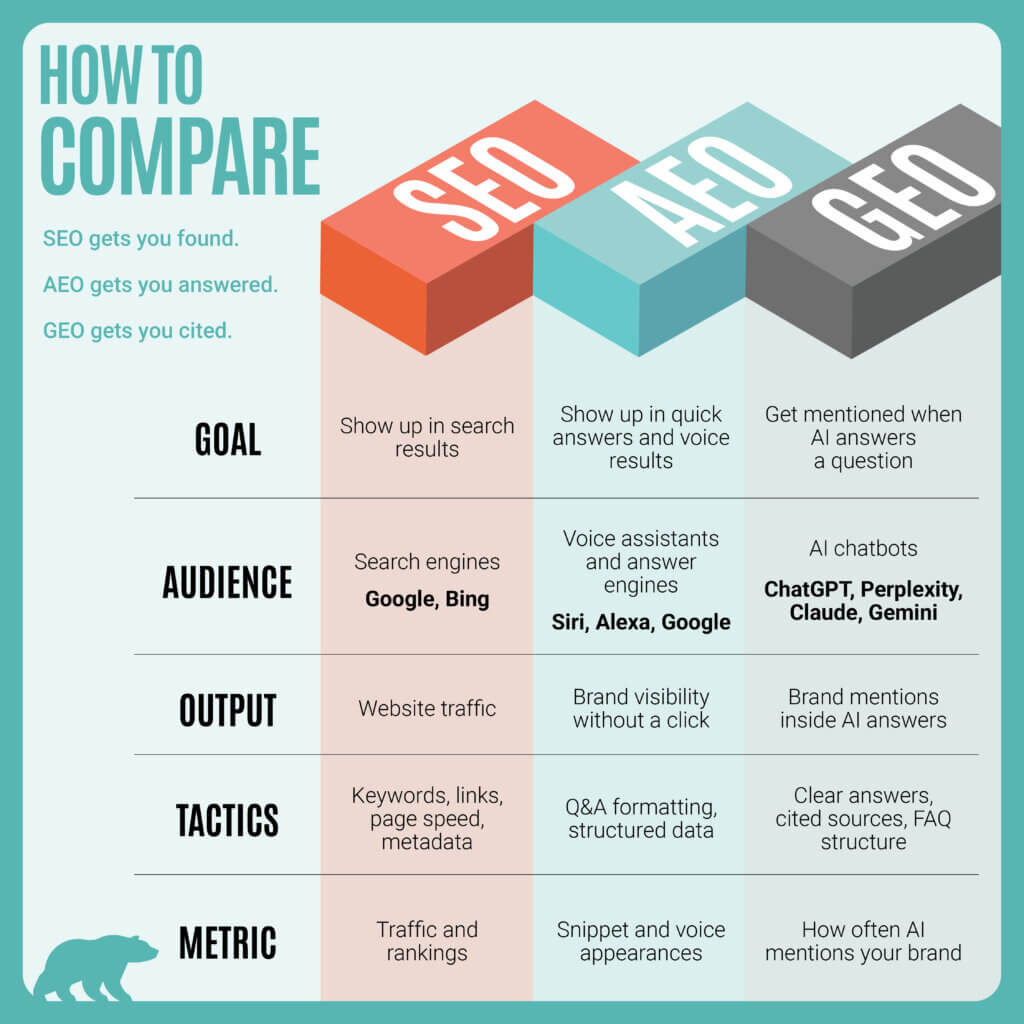
The easiest way to understand the three disciplines is by what each one optimizes for — and what it produces.
Search Engine Optimization (SEO) is the original discipline. It has been around for thirty-plus years, and its goal is simple: rank higher on traditional search engine results pages. The audience is search crawlers and algorithms. The output is a blue link that a user clicks through to your site. The tactics are familiar — keyword research, backlinks, technical site health. The metric is organic traffic, rankings, and click-through rate.
Answer Engine Optimization (AEO) emerged roughly ten years ago alongside voice search and featured snippets. Its goal is to win the direct answer — the box at the top of a Google results page, the response Alexa or Siri reads aloud. The audience is answer engines and voice assistants. The output is zero-click: your content IS the answer. The tactics shift toward FAQ schema, structured data, and Q&A formatting. The metric is snippet wins, voice coverage, and impressions — not clicks.
Generative Engine Optimization (GEO) is the newest discipline — roughly two years old. Its goal is to be cited inside AI-generated responses. The audience is large language models: ChatGPT, Perplexity, Claude, Gemini. The output is a citation inside an AI answer — not a link the user has to click, but a brand mention embedded in the answer itself. The tactics center on authoritative content and entity signals. The metric is citation rate, brand mention frequency, and AI visibility.
Why Do Food Brands Need to Think About All Three?
Because their buyers have changed how they search.
An operator researching a new protein supplier might open Google, scan the top results, and click through. That’s SEO. The same operator might ask Alexa or use Google’s AI Overview to get a fast answer about minimum order quantities. That’s AEO. And when that operator types “best foodservice ingredient suppliers for high-volume kitchens” into ChatGPT or Perplexity, the brands that surface as citations in the AI response are winning GEO.
The critical insight is this: a food brand that is only investing in SEO is visible in one of the three places its buyers are now looking. That’s not a search strategy — that’s a visibility gap.
And the gap widens quickly. GEO in particular is an early-mover discipline. The brands building authoritative, entity-rich content today will own citation share in AI answers before the field is crowded. Two years from now, catching up will be significantly harder.
“The food brands winning search in 2026 aren’t choosing between SEO, AEO, and GEO. They’re building content that earns all three — because the disciplines reinforce each other when you build them correctly.”
— Omnivore Agency
What Does a Layered Search Strategy Look Like for a Food Brand?
The strategic takeaway from the three-discipline model is that they are not mutually exclusive. Strong SEO fundamentals actively support AEO. Authoritative content built for AEO feeds GEO. Think of them as layered, not competing.
In practice, that means a food brand’s content strategy in 2026 should be built to do three things simultaneously. First, every piece of content should be technically sound and keyword-structured for SEO — crawlable, properly formatted, internally linked, and built around proven search terms.
Second, the content should be structured to answer questions directly. FAQ sections, defined terms, Q&A-formatted H2s, and schema markup are the AEO layer. The goal is to give answer engines and voice assistants a clean, citation-ready response to extract.
Third — and this is the GEO layer — the content needs to signal authority to large language models. That means entity clarity (who you are, what you do, what category you operate in), consistent citation across multiple credible sources, and content that answers the conversational prompts buyers are typing into ChatGPT and Perplexity today.
This is not three separate content programs. It is one content program built with three retrieval mechanisms in mind.
|
How Should Food Brands Start Building GEO Into Their Content Strategy?
GEO is the newest discipline and the least intuitive, so it’s where most food brands have the widest gap — and the clearest near-term opportunity.
Start with entity clarity. AI models retrieve and cite brands they can clearly identify: what you are, what you make, what category you own, and what problems you solve. If your website, your content, and your external mentions describe you inconsistently, LLMs will either ignore you or misattribute you. Consistent brand identity across all surfaces is the GEO foundation.
Next, build answer-first content. The posts and pages most likely to be cited by AI are the ones that answer specific, conversational questions directly and concisely — without requiring the AI to synthesize across multiple pages. This is the same discipline that drives AEO, which is why the two reinforce each other.
Finally, earn citations from credible external sources. Trade publications, industry associations, research reports, and partner content that mention your brand by name and in context are GEO signals. Every external citation tells an LLM that your brand is a legitimate, recognized entity in your category.
This aligns directly with what we covered in our post on why B2B food brands need to think like B2C brands. Clarity, consistency, and credibility are not just brand principles — they are the technical inputs that GEO rewards.
|
What’s the One Thing Food Brands Should Do First?
Audit your content for answer-readiness.
Pull your five highest-traffic pages and ask: if an operator typed a relevant question into ChatGPT, would this page give a clean, citable answer? Is there a defined term near the top? Are the H2s phrased as questions? Is there an FAQ section with self-contained answers? Is your brand entity described clearly — who you are, what you make, who you serve?
Most food brand content fails this test — not because the writing is bad, but because it was built for a search model that no longer reflects how buyers search. Retrofitting existing content for AEO and GEO is faster than building from scratch, and it compounds: every page you optimize becomes more visible across all three disciplines simultaneously.
Put SEO, AEO, and GEO together and you don’t just have a search checklist. You have a visibility strategy — one that reaches your buyer wherever they’re looking, in whatever format they’re searching, and in whatever voice they’re using to ask.
Ready to audit your content strategy against all three search disciplines — and close the visibility gaps before your competitors do? Let’s talk.
| ABOUT OMNIVORE AGENCY
Omnivore Agency is a food and beverage brand and marketing agency working exclusively with food brands across foodservice, CPG, and ingredient manufacturing. Our team pairs culinary, operator, and marketing expertise to help food brands translate category insight into commercial growth. |
FAQs
Q1. What is the difference between SEO, AEO, and GEO?
SEO ranks your content in traditional search results so users click through to your site. AEO positions your content as the direct answer extracted by voice assistants and featured snippets. GEO earns your brand citations inside AI-generated responses from tools like ChatGPT, Perplexity, and Gemini. Each optimizes for a different retrieval mechanism and a different user behavior.
Q2. What is generative engine optimization (GEO) for food brands?
GEO is the practice of structuring content and authority signals so AI language models — ChatGPT, Claude, Gemini, Perplexity — retrieve and cite your brand in their generated answers. For food brands, it means building entity clarity, answer-first content, and third-party citations that tell LLMs your brand is a credible, recognized authority in your category.
Q3. How do food brands rank in AI search results?
By building content that AI models can cleanly extract, attribute, and cite. That means consistent brand entity signals across your site and external sources, answer-first content structure with FAQ sections and defined terms, and credible external mentions from trade publications and industry sources. GEO rewards the same brand clarity that good marketing already demands.
Q4. Do food brands still need SEO if they’re investing in GEO?
Yes — and the disciplines reinforce each other. Strong SEO fundamentals improve AEO performance, and authoritative content built for AEO feeds GEO citation rates. A food brand that abandons SEO for GEO misses the compounding effect of all three. The modern search strategy treats them as layered disciplines, not alternatives.
Q5. How should food brands start with GEO?
Start with an answer-readiness audit of your highest-traffic content. Ask whether each page clearly defines your brand entity, uses Q&A-formatted headers, includes FAQ sections with self-contained answers, and has consistent external citations. Retrofitting existing content for GEO is faster than building from scratch and immediately improves visibility across SEO and AEO as well.
Sources
Search Engine Journal — GEO & AI Search Research
Semrush Blog — Generative Engine Optimization
BrightEdge — AI Search Visibility Research
Google Search Central — Structured Data Documentation
Food Business News — Digital Marketing Coverage