
Sysco Q3 2026 Earnings: The Restaurant Depot Deal Changes Everything
April 28, 2026
| QUICK ANSWERS
What did Sysco report for Q3 2026? What is the Sysco Restaurant Depot acquisition? When will the deal close? |
Sysco reported Q3 fiscal 2026 earnings this morning. The numbers were solid. But the quarterly print is almost beside the point. What matters for food and beverage brands right now is the seismic deal Sysco announced in March — and what it means for the distribution landscape every F&B marketer depends on.
Here is what you need to know.
By the Numbers: Sysco Q3 2026 at a Glance
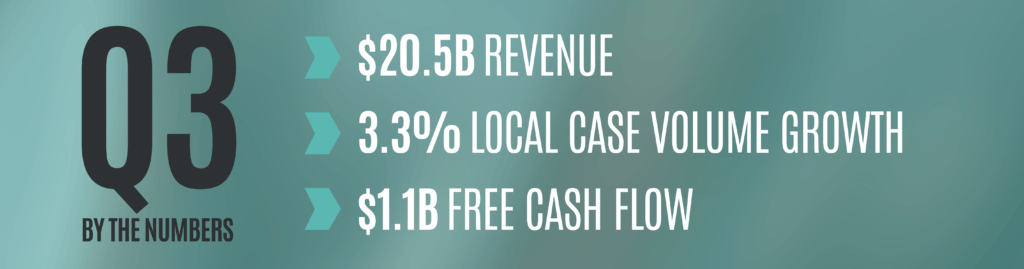
Sysco posted $20.5 billion in Q3 sales, up 4.7% year-over-year. U.S. local case volumes — the best proxy for restaurant channel health — grew 3.3%, the strongest quarterly rate in more than three years. Gross profit rose 6.5% to $3.8 billion, with gross margins expanding in the quarter.
Adjusted EPS came in at $0.94, down slightly from a year ago. That modest decline is almost entirely explained by a $63 million incentive compensation headwind management has flagged all year. Year-to-date free cash flow hit $1.1 billion, up 19%. Full-year adjusted EPS guidance was maintained at the high end of the $4.50 to $4.60 range.
The stock is trading modestly lower today. But investors aren’t spooked by the quarterly numbers. They are still processing what Sysco announced four weeks ago.
What Is the Sysco Restaurant Depot Acquisition?
 On March 30, Sysco announced a definitive agreement to acquire Jetro Restaurant Depot for $29.1 billion in cash and stock — the largest deal in the company’s 56-year history.
For context: Restaurant Depot is a cash-and-carry wholesale warehouse chain with 166 locations in 35 states. It generates $16 billion in annual revenue and serves roughly 725,000 independent restaurant operators who prefer to shop in person, pay upfront, and skip the delivery model entirely.
That last part matters. For years, Restaurant Depot has functioned as a real-world pricing check on companies like Sysco. When broadline delivery costs crept up, independent operators could comparison shop at the warehouse. That competitive dynamic kept pricing pressure on the distribution giants.
With this acquisition, both options will sit inside the same corporate structure.
What Does the Restaurant Depot Acquisition Mean for Independent Restaurants?
Sysco has committed publicly that Restaurant Depot will operate as a standalone division, maintain its existing pricing model, and not introduce membership fees. Company leadership has repeatedly stated there is “minimal overlap” between the two customer bases.
But the restaurant industry is watching closely. A New York state assemblymember has already written to the FTCrequesting an antitrust review, citing the agency’s successful block of Sysco’s attempted acquisition of US Foods in 2015. Sysco’s counterargument — that broadline delivery and cash-and-carry are fundamentally different channels serving different customers — is the same logic that passed regulatory scrutiny over a decade ago. Whether that holds today is the central open question.
This is the kind of industry consolidation dynamic our team has been tracking closely in recent weekly roundups.
Why F&B Brand Marketers Should Pay Attention
Distribution consolidation is not just an investor story. It directly shapes the playing field for every food and beverage brand selling into the restaurant channel.
When fewer distributors control more of the market, the negotiating calculus shifts. Trade spending programs, placement priorities, promotional windows — all of it gets renegotiated in an environment where your brand has fewer alternatives and the distributor has more leverage. This is a pattern the industry has seen before, and it tends to accelerate after major M&A activity closes.
The foodservice distribution market has grown from $161 billion in 2000 to $377 billion today, with Sysco holding an 18% share. A combined Sysco and Restaurant Depot entity would approach a scale with few real parallels in the industry’s history.
For F&B brand marketers, understanding your distributor relationships — and building brand pull with end operators that makes you harder to de-list — becomes a more important strategic priority, not a less important one. Omnivore’s data-driven advertising capabilities are built precisely for this kind of environment, where brand strength at the operator level is your best hedge against distribution risk.
Four Things to Watch Over the Next 12 to 24 Months
1 |
FTC Regulatory Outcome | The agency’s posture on this deal will signal a great deal about the current administration’s appetite for large-scale foodservice consolidation. A block reshapes the whole story. Approval sets a precedent. |
2 |
Pricing Dynamics for Independent Operators | If the deal closes, independent restaurant operators lose a meaningful pricing benchmark. Watch for cost pressure signals in operator-focused surveys and trade coverage. |
3 |
Competitor Response | US Foods and Performance Food Group will be watching Sysco’s integration closely. Any management distraction during integration creates an opening. This is likely to be one of the most competitive periods in broadline distribution in years. |
4 |
Your Brand’s Distribution Strategy | If you are a food or beverage brand selling into foodservice, now is the right time to audit your distributor relationships and evaluate how your marketing investment is building demand at the operator level. |
Our team works with CPG and foodservice brands navigating exactly this kind of market shift. If you want to talk through what this means for your brand’s distribution marketing strategy, we’d like to hear from you.
The Bottom Line
Sysco’s Q3 numbers were fine. The company is executing, volumes are growing, and cash flow is strong. But the quarterly earnings release is a footnote compared to what is actually happening here. A $29 billion bet on the future of foodservice distribution is unfolding in real time, with meaningful implications for independent operators, competing distributors, and every food and beverage brand that sells through the restaurant channel.
This is one to watch.
Sources
Sysco Q3 FY2026 Earnings Release: investors.sysco.com | CNBC Acquisition Coverage: cnbc.com | Restaurant Business: restaurantbusinessonline.com | Spectrum News NY: spectrumlocalnews.com