

Crafting Content Strategies That Build Business
July 28, 2022
This post focuses on why strategic thought should be given to crafting an integrated and comprehensive content strategy — a very important component of a brand’s overall marketing planning. While a highly effective content strategy can be executed with some straightforward and proven tactics, it is important to understand that a broad spectrum of inputs should be considered — just as thoughtfully ideating any type of business and marketing strategy warrants strategic ideation. As with any strategic marketing initiative, the primary goal is to carefully identify your brand’s key points of differentiation and compelling propositions that clearly align with the wants and needs of your customers. From sales enablement and marketing activation to communication tactics — including an overall content strategy — each of these elements should ladder up to the macro marketing strategy, working in synergy to achieve your specific marketing objectives.
For example, if your business is a startup looking to launch a new product or service or an established brand adding offerings to an existing lineup, or a tech-centric organization attempting to penetrate a new industry, you need to be able to communicate details about your products or services in ways that resonate with your target audiences — while also differentiating your company and its offerings in a relevant and meaningful way from competitors. Identifying white space opportunities where your brand can fill unmet needs will allow your brand to stand out in often crowded categories of the market. The key is to thoughtfully assess the competitive set and determine how best to activate against and engage with your targets using a variety of communication tools and content tactics
Beginning With The Essentials
To successfully develop and inform your content strategy, several key foundational elements should be identified — most importantly ensuring your brand strategy and positioning exercises are complete. These foundational building blocks include:
- Market/competitive white space identification & analysis.
- Industry/market trends assessment.
- Brand purpose, pyramid & positioning statements.
- Brand persona and pillar identification.
- Sub-brand integration and key messaging dissemination.
Once your brand strategy is in place and positioning work accomplished, a solid foundation will have been laid to aid in developing a strategically informed content strategy. For a refresher on how and why foundational strategic components are so imperative to an effective marketing plan, read our article the Power of Foodservice Personas.
A Winning Strategy
A successful content strategy is focused on consistently creating and disseminating relevant, valuable content to attract and retain a well-defined audience set with the goal of generating leads and, most importantly, sales. Your content strategy should align with your brand positioning as well as your business objectives and marketing goals. Is your company trying to increase brand awareness? Do you want to drive more traffic to your blog? Are you looking to generate more leads? Answers to these questions will determine the type of content you create and where and how you share your content with your desired audiences.
You also need to consider the three stages of a buyer’s journey—Awareness, Consideration, Decision—to ensure the content your crafting resonates with your audience prospects in each stage. What problems or pain points do they face? Which solutions do your products or services solve? What incentives or next steps can you provide to sway the decision process? Creating a variety of diverse types of content that support each stage of the journey will set your brand up for success and stronger customer relationships.
Importantly, content creation is not a one-person responsibility. Leverage internal sales and marketing teams, influencers, and industry partners to collaborate on content ideation. Once you have a collection of content created, the next step is sharing and promoting the content across multiple channels to garner the greatest reach and impact — including your website and blog, social media channels, pay-per-click (PPC) promotion, as well as third-party partners and sponsorships. Continue reading as we break down some of the specific keys to crafting an effective content strategy that is truly compelling.
Why Content Matters
Producing high-quality content that attracts your prospects and keeps them engaged throughout each stage of the buyer journey is essential for converting prospects into customers. In today’s digital-centric world, consumers are exposed to and receive an inordinate amount of disparate content daily — from ads to newsletters to videos and much more. And with much of that content being ignored or deleted altogether, it is even more critical to ensure your brand’s content is relevant and topical to your targets.
We fully acknowledge creating compelling content can be challenging. In fact, 65% of B2B marketers struggle to define which content is effective, and 60% state producing engaging content is their biggest challenge.1 This is where the importance of solidifying your brand positioning work is critical to inform your content strategy. Once this upfront positioning work is complete, you will be able to more easily craft the type of meaningful content that is most pertinent to your target audience. HubSpot reveals that 50% of consumers spend their time engaging with custom content while 73% of consumers become frustrated with irrelevant web content. As such, creating a library of content pieces tailored to your defined targets is proven to resonate with your targets in ways that compel engagement and purchase.
Lower Investment, Higher Lead Generation
Demand Metrics, for example, reveals that content marketing costs 62% less than traditional marketing yet generates nearly three times as many leads. By way of example, just one piece of content can be distributed across multiple channels — from your website to social posts to blogs, newsletters, and more. Over a short period of time, this content then culminates into a trove of compelling information to relay about your company, brands, products, or services. Plus, as alluded to above, internal brand and marketing team members can be tapped as subject matter experts to help craft content that helps reinforce your brand’s relevance and credibility while also helping to further educate your audience.
One piece of content can be dispersed across multiple channels. Source: Getty Images
Authentic and evergreen content is essential when trying to engage with your targets and differentiate your brand from competitors. McMurray/TMG reveals that 90% of consumers find custom content useful, and virtually 80% believe the organizations behind the content are interested in building meaningful relationships. As stated, the content you push to market is proven to attract, convert, and retain customers — with little upfront investment or drain from your overall marketing dollars. For a deeper dive, please take a moment to read our post entitled Tips to Convert Leads Into Lifelong Customers to learn more about how content can effectively drive bottom-line sales.
Format And Frequency
Whether focusing on your product’s features and benefits or your organization’s specific brand story or engaging your targets with recipe reels and simple how-to videos, organizing your content while strategically leveraging various social channels allows you to disseminate your content on a consistent cadence.
Mix It Up
To reach more of your targeted customers, make sure to integrate multiple channels and a mix of owned, earned, and paid platforms for disseminating your content.
- Use your social channels for pushing engaging content to existing audiences and new targets. With a strong call to action, social posts can build brand awareness, boost conversions, generate leads, and encourage customers to continue to engage with your company.
- Look to industry partners, publication sponsorships, and digital advertising to reach a broader, yet targeted audience set beyond what you can achieve organically.
- Your website is the ideal place to house your content and drive traffic. Ensure content is relevant, organized, and easy to find or search for to provide the best user experience for visitors.
Be Versatile
Keep content fresh and inviting by using a variety of formats and tactics.
- Long-form: blogs, articles, case studies, and white papers are all types of long-form content that can be used for educational and thought leadership purposes.
- Graphics: images, memes, listicles, and infographics are quick, visually appealing formats for relaying information and storytelling.
- Lead generation: newsletters, surveys, and quizzes engage your audience and provide the perfect format for capturing customer information for follow-up communications.
- Video/audio: webinars, tutorials, reels, and podcasts allow your company to connect deeper with audiences by highlighting details about products and services and showcasing the expertise and experience you bring to your specific industry.
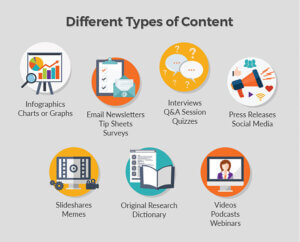
Utilize a variety of content types to keep audiences engaged and support each stage of the buyers’ journey.
Keep your arsenal of content organized and on a consistent cadence by creating quarterly or monthly content calendars by platform and topic focus. This provides guardrails to ensure you’re sharing on multiple channels and covering a range of topics and format types. Content calendars should align with your broader marketing plan to reinforce that messaging is consistent and meets overall marketing objectives.
Summary
A well-crafted content strategy ensures that every piece of content serves a specific and defined purpose for your business. Thoughtful, relevant, and authentic content builds brand awareness and helps generate leads and conversions with little overall investment. Whether you’re a B2B brand in need of help developing a content strategy and topical content ideas or a B2C brand looking to reposition your existing consumer-facing voice — or you’re seeking assistance with competitive analysis and market research, brand persona development, or any other business-building initiative, we offer a suite of services to our client partners that can be specifically tailored to your individual needs. Contact us today.
For additional marketing insights and content creation, read our blogs Influencer Marketing Can Amplify B2B & B2C Brand Engagement and Blogs Are As Important Than Ever.
1CMI Media