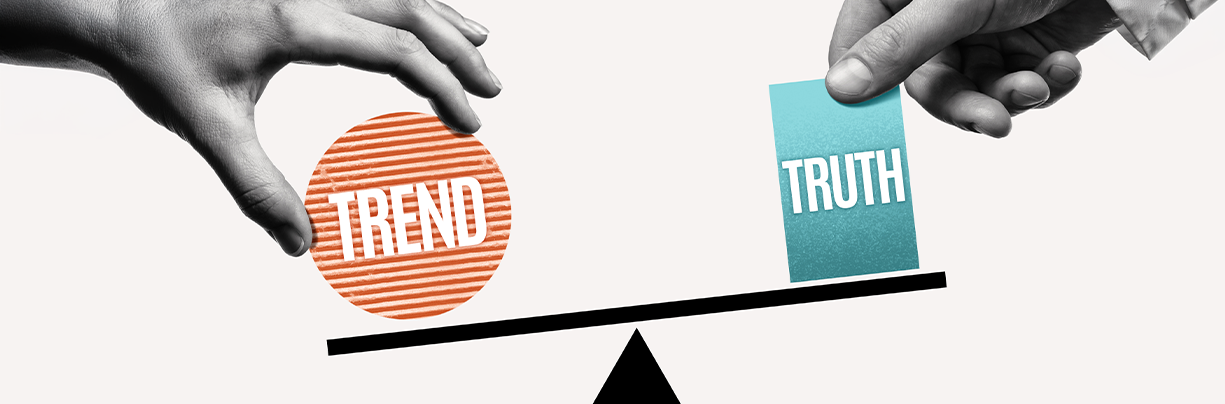
Trend vs. Truth: What’s Driving Food in 2026
June 23, 2026
The Real Forces Shaping the Food Industry Right Now
Cutting Through the Noise to Find What’s Actually Moving Operators, Retailers, and Brands in 2026
Every year, a handful of trends absorb most of the conversation and budget in food and beverage marketing. Sometimes they deserve it. More often, the actual drivers of growth and challenge in the industry are quieter, less headline-friendly, and more useful to understand.
In 2026, the gap between the trend narrative and the operational reality is wider than usual. Here is what is actually happening.
Which Food Industry Trends Are Actually Overhyped Right Now?
Three narratives are absorbing disproportionate attention this year.
The first is AI as a strategic game changer for food brands. The tools are real. The efficiency gains at the tactical level are genuine. But the claim that AI is transforming how food brands connect with consumers is ahead of the evidence. Most AI applications in food marketing are improving execution, not strategy. Generating content faster is not the same as generating better strategy. Brands treating AI as a creative strategy shortcut are discovering what shortcuts always deliver: speed without direction.
The second is retail media as the answer for every brand. Retail media is a legitimate growth channel. It is optimized for brands with significant trade budgets, deep retailer relationships, and category authority already established. For mid-size and emerging food brands, the pitch often outpaces the reality. Retail media amplifies brands that are already working. It does not fix brands that have not yet earned the shopper’s attention.
The third is premiumization as a universal growth strategy. For years, the narrative was straightforward: consumers will pay more for better. It is still partly true. But 40 to 47 percent of consumers across income levels now identify as value seekers, including 35 percent of high-income households. The market is bifurcating. The middle is being squeezed. Premiumization works, but only for brands with a clear and specific reason why this product costs more. A functional benefit. A cleaner ingredient deck. A sourcing story that holds up. Generic premium is losing to specific value.
What Is Actually Driving the Food Industry Right Now?
While those three narratives collect the attention, three quieter dynamics are doing most of the work.
The first is value pressure and market bifurcation. Nearly two-thirds of consumers entering 2026 remained extremely or very concerned about food prices. Private label dollar sales hit an all-time high for the year ending late 2025, according to Circana. The brands winning in this environment are not the ones with the lowest prices. They are the ones with the clearest value stories. Affordability is not just about price. It is about whether the consumer can answer the question “Is this worth it?” before the purchase is made.
The second is the GLP-1 behavioral shift. Roughly 23 percent of U.S. households now include someone using a GLP-1 medication. These households have reduced grocery spending by around 6 percent in the first six months, with the biggest reductions in processed and sugary products. By 2030, analysts project these households will represent 35 percent of all food and beverage units sold. This is not a niche wellness trend. It is a structural shift in consumption that is already showing up in purchase data. Brands that have not started adjusting product mix, portion sizing, or messaging are already behind.
The third is operator demand for simplicity and execution certainty in foodservice. Operators are rationalizing menus, cutting SKUs, and prioritizing reliable supply over innovation. The brands winning distribution are the ones making the operator’s job easier, not more complex. A new product that adds prep steps, requires specialized training, or introduces supply uncertainty is fighting the current. A product that removes friction wins.
Is Premiumization Still a Growth Strategy for Food Brands?
Yes, but with conditions. The blanket narrative that all consumers are trading up is no longer supported by behavior. The market is splitting, and brands caught in the middle are losing share to both value-priced and genuinely differentiated products.
The premiumization that is working in 2026 is specific. Functional benefits consumers can verify. Ingredient transparency that earns trust. Sourcing claims that hold up to a Google search. The consumer’s question has shifted from “Is this premium?” to “What specifically makes this worth more?” Brands that can answer that question immediately and credibly are winning. Brands that answer it with adjectives are not.
How Do Food and Beverage Brands Respond to Value-Seeking Behavior?
The instinct is to cut price. The evidence says that is rarely the right answer.
The brands that are holding share in a value-seeking market have done something different. They have made their value legible. What does the consumer get that they cannot get elsewhere, at this price point, in this format? If the brand can answer that question clearly, price becomes a smaller barrier. If the brand cannot answer it, no price point feels right.
This applies across segments. In foodservice, it means making sure operators can tell a clear story about what your product does for their operation and their guest. In retail, it means packaging, positioning, and product communication that lets the shopper evaluate the trade-off quickly and confidently.
How Should Food Brands Separate Real Trends from Industry Noise?
The simplest test is whether a trend is changing behavior at the register. Social media buzz, trade publication coverage, and conference keynote attention are proxies for cultural reach. They are not measures of commercial impact.
GLP-1 is changing what people buy. Value pressure is changing how much and where they buy. Operator simplification is changing what gets to the menu. These are measurable. They trace from trend to behavior to purchase.
AI in food marketing is changing how fast brands produce content. That is not the same as changing how well brands connect with consumers. Retail media is changing how some brands reach shoppers on the path to purchase. That is not the same as building the brand preference that puts a product on the consideration list in the first place.
Circana projects U.S. food and beverage volume growth at negative to flat for 2026. That is not a forgiving environment for brands without a clear position. The ones performing have made strategic choices about what they are and who they are for. The ones chasing the trend narrative are moving fast in the wrong direction.
Track what is changing behavior. Invest where behavior is actually moving. That is the framework that holds regardless of which trend cycle the industry is in.
|
Need help separating signal from noise in your category and building a strategy that responds to what is actually moving your buyers? That is the work we do every day.
Ready to get started? Contact Us
FAQs
Q1. What food industry trends are overhyped in 2026?
The three most overhyped trends in food and beverage marketing right now are AI as a strategic transformation tool (rather than a tactical efficiency gain), retail media as a universal solution for brands of all sizes and budgets, and premiumization as a growth strategy that works regardless of whether the brand has a specific, credible reason why it is worth more.
Q2. What is actually driving food brand growth in 2026?
Three real drivers are doing most of the work: value pressure and market bifurcation (nearly two-thirds of consumers remain highly concerned about food prices; private label is at all-time highs), the GLP-1 behavioral shift (23 percent of U.S. households now include a GLP-1 user, and these households have reduced grocery spend by about 6 percent), and operator demand for simplicity and supply reliability in foodservice.
Q3. Is premiumization still a growth strategy for food brands?
Yes, but only with specificity. Roughly 40 to 47 percent of consumers now identify as value seekers, including 35 percent of high-income households. The middle market is being squeezed. Premiumization works for brands that can answer immediately and credibly why their product costs more. Generic premium is losing to specific, demonstrable value.
Q4. How is GLP-1 affecting food and beverage brands?
Significantly. Roughly 23 percent of U.S. households include someone using a GLP-1 medication. These households have reduced grocery spend by about 6 percent in the first six months, with the biggest cuts in processed and sugary products. By 2030, analysts project these households will represent 35 percent of all food and beverage units sold. Brands that have not started adjusting product mix or messaging are already behind the shift.
Q5. How do food brands separate real trends from industry noise?
The simplest test is whether a trend is changing behavior at the register, not just generating trade press coverage or conference keynote attention. GLP-1, value pressure, and operator demand for simplification are measurable. They trace directly from trend to behavior to purchase. That is the test worth applying to every trend claim before making an investment.
Sources
Circana: U.S. Food and Beverage Outlook 2026
Datassential: Food Industry Trends and Research
Food Dive: Food and Beverage Trends 2026
Clarkston Consulting: 2026 Food Industry Trends